Qeltrivo
Drift Library
Drift Library
Couldn't load pickup availability
- Problem Statement
Many learners reach a point where basic Assembly examples are no longer enough, but larger code fragments still feel difficult to read with order and patience. They may understand registers, labels, and memory references separately, yet struggle when these parts appear together in a longer sequence. Another common challenge is losing track of values when code changes direction, repeats instructions, or moves data through several locations. Learners may also find that short tutorials do not provide enough review material to build a steady study routine. Drift Library was created for learners who need a broader course tier with more examples, more reading practice, and more organized reference material.
- Solution
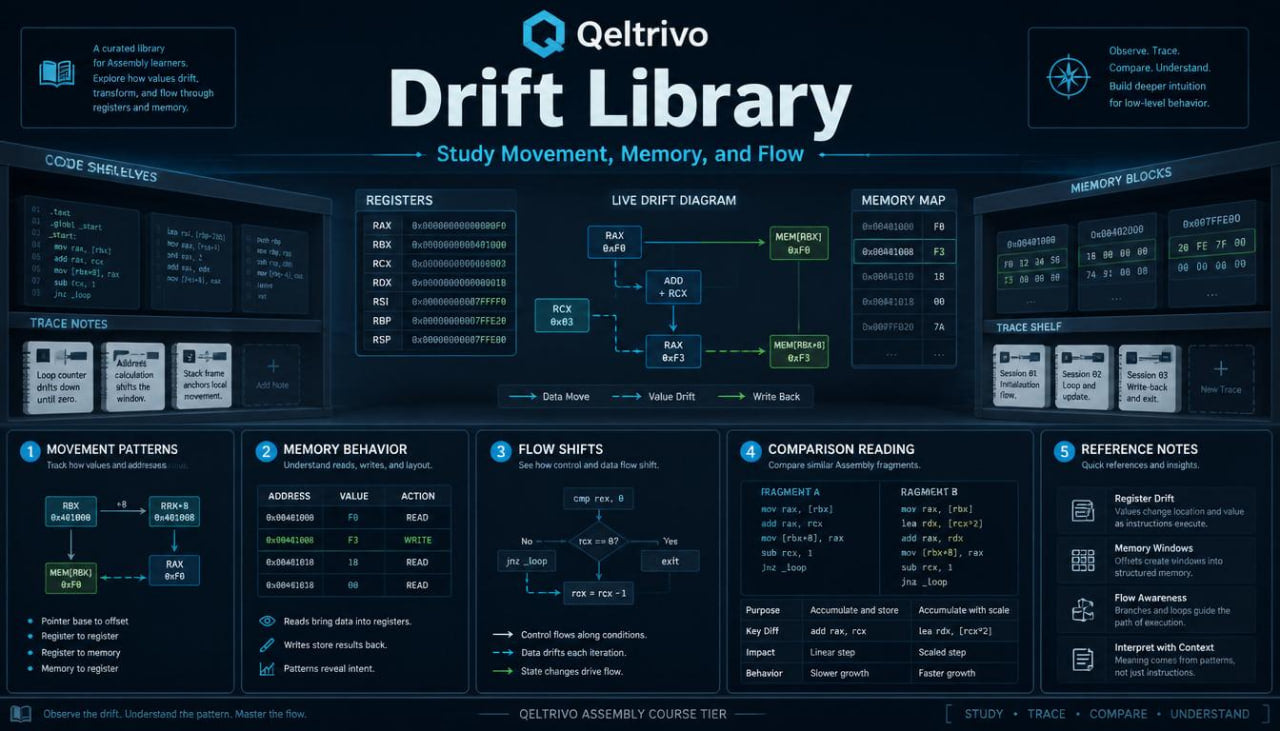
Drift Library gives learners a deeper Assembly study path built around connected modules and detailed examples. The course focuses on how values move, how memory references shape code behavior, and how instruction groups can be read as part of a wider structure. Learners work through guided explanations, trace tasks, comparison notes, and review sections that make longer fragments easier to examine. The materials are arranged so learners can return to earlier ideas while adding new layers of understanding. This tier helps learners develop a steadier reading method for Assembly code that contains more movement, more conditions, and more connected details.
- What’s Inside
Drift Library begins with a foundation review designed to refresh the main ideas from earlier Qeltrivo tiers. Learners revisit registers, instructions, operands, labels, memory references, and code flow. This opening section is not a repeat of basic material; it is a careful re-entry point that shows how familiar concepts become more important when code fragments grow longer.
The first main module focuses on movement patterns. Learners study how values pass between registers, memory references, and instruction groups. The module includes short examples that show direct movement, copied values, updated values, and value changes across several lines. Each example is followed by a reading note that explains what changed, where the change happened, and why that line matters in the wider fragment.
A second module explores memory behavior in more detail. Learners review how memory-related instructions can shape the meaning of a code fragment. The course explains how to identify whether a value is being read, written, reused, or changed. Diagrams and trace tables help learners follow these actions without relying only on memory terms. The emphasis is on observation: seeing what the code is doing before trying to describe the whole fragment.
Drift Library also includes a module on flow shifts. Learners study labels, jumps, branches, and repeated code paths through carefully selected examples. The materials show how to follow execution when it does not move in a straight line. Learners practice marking where code may continue, repeat, or move to a different section. This helps make branching behavior more understandable in a practical study setting.
Another part of the course focuses on comparison reading. Learners are shown pairs of similar Assembly fragments and asked to notice what is different between them. One fragment may move a value in a different order, use another register, or change a condition. These comparison tasks help learners sharpen attention to small details, which is important when reading Assembly.
The tier also includes a reference library section. This section contains concise explanations of recurring Assembly ideas, such as register state, memory reference, instruction grouping, branch reading, trace notes, and value history. It is designed as a companion to the course modules, so learners can revisit definitions while working through practice tasks.
Drift Library includes guided walkthroughs that are longer than those in earlier tiers. Each walkthrough is divided into smaller reading moments. Learners first identify the instruction type, then track values, then follow code direction, and finally write a plain-language explanation of the fragment. This creates a repeatable reading routine that can be used across multiple examples.
The practice section contains worksheets with several task types. Learners may complete trace tables, mark flow direction, explain memory movement, compare two code fragments, or rewrite a technical observation in plain language. These exercises are meant to make the course more active and give learners a clearer way to review the material.
The final section brings the course together through an integrated reading activity. Learners examine a longer Assembly fragment, break it into smaller parts, track value changes, identify flow shifts, and describe the role of each section. This activity helps connect the modules into one practical study experience.
- Who Is This For?
Drift Library is for learners who already understand basic Assembly reading and want a wider course tier with more examples and deeper study materials. It fits people who can follow short instruction groups but still feel uncertain when code includes several value changes, memory references, or branches.
This tier may be useful for learners who prefer organized modules, reference notes, diagrams, and repeated practice. It is also suitable for people who want to improve their ability to explain Assembly fragments in plain language. Learners who completed Lattice Deck may find Drift Library to be a natural next course because it expands the same ideas into broader reading tasks.
Drift Library is not meant for learners who only want a brief overview. It is made for people who want to spend more time with Assembly examples, revisit concepts from different angles, and build a more patient reading process.
- What You’ll Learn
- How to follow value movement across longer Assembly fragments
- How to identify reading and writing behavior in memory-related instructions
- How to track register changes through several connected lines
- How to follow labels, branches, and repeated code paths
- How to compare similar Assembly fragments and notice small differences
- How to use trace tables as part of a study routine
- How to describe memory behavior in plain language
- How to break longer code fragments into smaller reading sections
- How to use reference notes while reviewing course materials
- How to connect movement, memory, and flow into one reading method
- 30-Day Refund Note
Drift Library follows the Qeltrivo 30-day refund policy for paid course orders. A learner may request a refund within 30 days of purchase when the request matches the store policy conditions. This gives customers a clear review period for the course materials while keeping the process simple, fair, and transparent.
Self-paced learning overview
- 📁 Digital file available after purchase
- 🕒 Long-term availability
- 🔐 Secure checkout
- 🧩 Content updated in 2026
How are the course tiers different?
How are the course tiers different?
Each tier offers a different amount of learning material, structure, and depth. Lower tiers are lighter and more introductory, while higher tiers include broader topic coverage, more guided practice, and deeper Assembly-focused study materials.
Do I need previous Assembly knowledge?
Do I need previous Assembly knowledge?
Some tiers are made for learners who are new to Assembly, while others are better for people who already understand basic programming ideas. Each tier description explains who it is made for, so learners can choose the path that fits their current level.
What format do the materials use?
What format do the materials use?
Qeltrivo courses may include written lessons, modules, diagrams, examples, guided exercises, reference notes, and practice-based materials. The focus is on organized learning, clear explanations, and practical study flow.
Share