Qeltrivo
Free Map
Free Map
Couldn't load pickup availability
- Problem Statement
Assembly can feel difficult to approach because many learning materials begin with dense terminology, abstract ideas, or disconnected examples. New learners often see registers, memory, instructions, and low-level logic introduced too quickly, which can make the subject feel scattered. Another common issue is that many resources explain isolated commands without showing how they fit into a wider mental model. Learners may also struggle to understand why Assembly matters when they cannot yet connect small code patterns to machine-level behavior. Free Map was created for people who need a clear first orientation before moving into deeper study.
- Solution
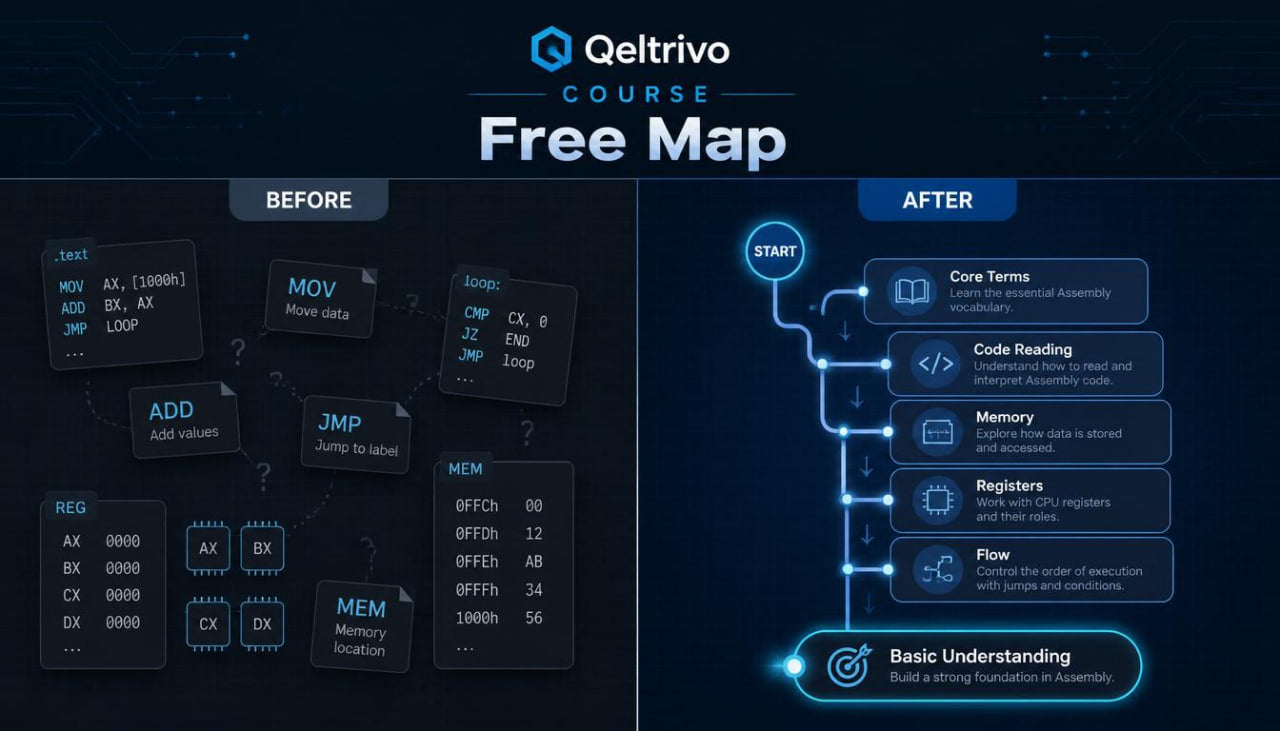
Free Map gives learners a structured first view of Assembly without overloading them with too many technical layers at once. It introduces core ideas in a measured way, using simple explanations and short study sections that help learners recognize the shape of the subject. Instead of pushing advanced material too early, this tier focuses on orientation, vocabulary, and basic relationships between instructions, memory, and program flow. The materials help learners see Assembly as a system of small connected ideas rather than a wall of unfamiliar syntax. Free Map is intended to make the first step more understandable before learners choose a deeper Qeltrivo course tier.
- What’s Inside
Free Map includes a compact introduction to the Qeltrivo learning style and a carefully arranged set of starter materials for Assembly study. The tier begins with a short orientation section that explains what Assembly is, why it is different from higher-level coding, and how learners can think about it without feeling lost in technical details. This section uses plain language and avoids unnecessary complexity, making it suitable for learners who want a guided first look.
The next part introduces the basic building blocks of Assembly thinking. Learners meet key ideas such as instructions, registers, memory, values, labels, and program flow. Each idea is explained as part of a larger picture, so the learner can understand not only what the term means, but also how it relates to other parts of the system. The goal is not to cover every detail, but to create a clear starting framework.
Free Map also includes a small set of example-based notes. These notes show how simple Assembly-style instructions can be read and interpreted. Learners are guided through the meaning of small code fragments, with attention to what each line is doing and how the machine-level idea can be understood step by step. The examples are intentionally short, so learners can focus on reading patterns rather than memorizing long sequences.
A study map is included to help learners understand how the wider Qeltrivo course collection is organized. This map outlines the kind of topics that may appear in later tiers, such as memory handling, control flow, data movement, structured exercises, and deeper code reading. It gives learners a sense of direction while keeping the Free Map tier light and approachable.
The tier also includes reflection prompts. These prompts help learners think about what they already understand, what feels unfamiliar, and which topics they may want to study next. This is useful for choosing a later tier because it gives learners a practical way to identify their current needs.
A short terminology section is also part of the materials. It gives simple explanations for common Assembly-related words, helping learners reduce confusion before they begin larger lessons. This section can be used as a small reference while reviewing the starter examples.
Finally, Free Map includes a course selection note that explains how learners can move from this introductory tier into another Qeltrivo option. It does not pressure learners toward a specific choice. Instead, it gives a calm overview of how each tier may fit different study goals, background levels, and preferred learning depth.
- Who Is This For?
Free Map is for learners who are curious about Assembly but do not want to begin with a heavy technical course right away. It is suitable for people who have heard about low-level programming and want to understand what the subject looks like before choosing a larger study path. It can also be useful for learners who already know some coding concepts but feel unsure about how Assembly differs from other programming styles.
This tier is also for people who prefer to preview the tone, structure, and explanation style of Qeltrivo before moving further. Since it is a starting tier, it does not assume strong Assembly knowledge. It is made for orientation, not deep completion. Learners who want a small, organized introduction can use Free Map as a first checkpoint.
Free Map may also fit students, hobby learners, technical readers, and self-guided learners who want a short overview without dramatic marketing claims. It gives enough material to understand the learning direction while leaving deeper work for the paid tiers.
- What You’ll Learn
- How Assembly differs from higher-level coding styles
- What instructions, registers, and memory represent in a basic learning context
- How small Assembly-style code fragments can be read line by line
- How values move through simple low-level operations
- How program flow can be understood through labels and basic instruction order
- How to recognize common Assembly-related terms
- How to think about Assembly as a structured subject rather than separate commands
- How Qeltrivo organizes its course collection
- How to decide which topic area may be useful for your next study step
- How to review starter materials without rushing into advanced sections
- 30-Day Refund Note
Free Map has no paid order, so a 30-day refund option is not needed for this tier. For paid Qeltrivo course tiers, customers can follow the store refund policy within 30 days of purchase when the request meets the listed conditions. This keeps the purchase process clear while giving learners time to review whether the selected course materials fit their study needs.
Self-paced learning overview
- 📁 Digital file available after purchase
- 🕒 Long-term availability
- 🔐 Secure checkout
- 🧩 Content updated in 2026
How are the course tiers different?
How are the course tiers different?
Each tier offers a different amount of learning material, structure, and depth. Lower tiers are lighter and more introductory, while higher tiers include broader topic coverage, more guided practice, and deeper Assembly-focused study materials.
Do I need previous Assembly knowledge?
Do I need previous Assembly knowledge?
Some tiers are made for learners who are new to Assembly, while others are better for people who already understand basic programming ideas. Each tier description explains who it is made for, so learners can choose the path that fits their current level.
What format do the materials use?
What format do the materials use?
Qeltrivo courses may include written lessons, modules, diagrams, examples, guided exercises, reference notes, and practice-based materials. The focus is on organized learning, clear explanations, and practical study flow.
Share