Qeltrivo
Grid Module
Grid Module
Couldn't load pickup availability
- Problem Statement
As Assembly study becomes deeper, learners often face code fragments that contain many moving parts at the same time. A value may begin in one register, move into another place, appear in a memory reference, then influence a later branch. When this happens, it can be difficult to keep every detail organized without a steady note-taking method. Learners may also struggle to decide which lines belong together and which instructions should be studied as separate sections. Grid Module was created for learners who need a more organized way to place Assembly details into a readable structure.
- Solution
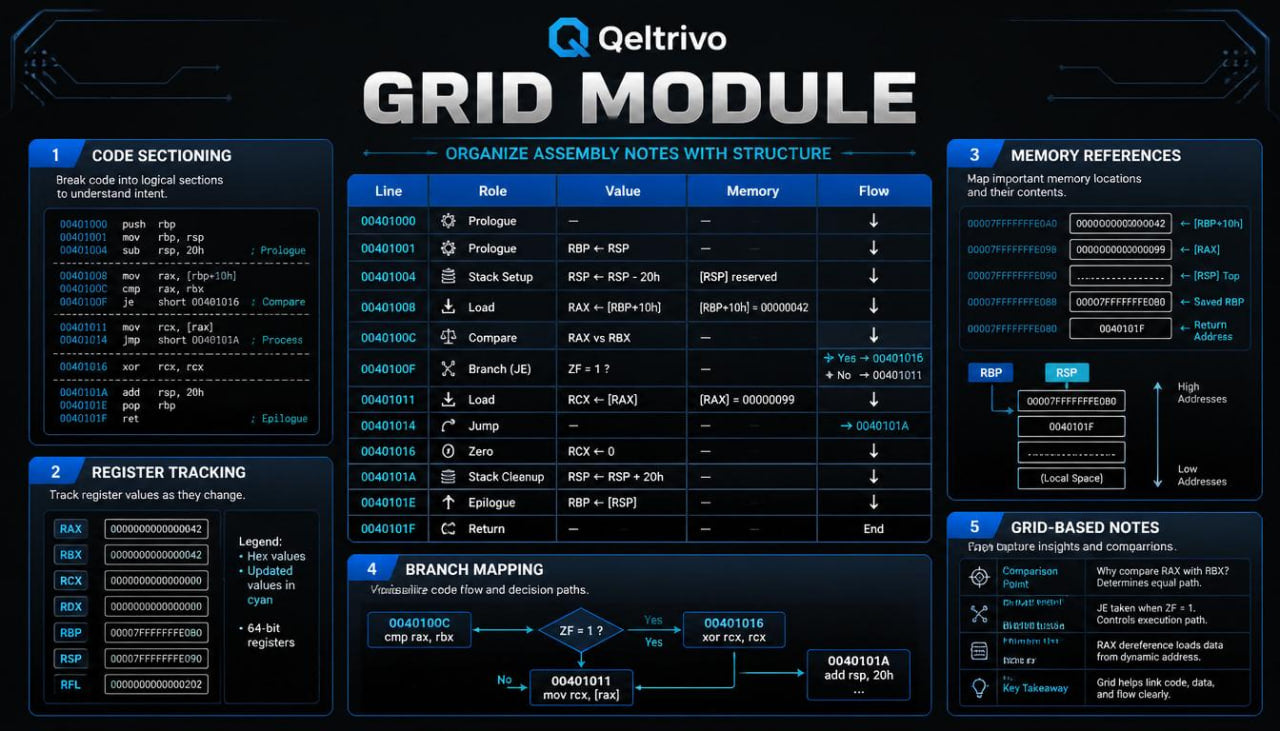
Grid Module gives learners a structured method for arranging Assembly observations into a clear study layout. The course teaches learners how to divide code into sections, trace values through each section, identify memory roles, and follow branch movement with careful notes. Instead of reading a fragment as one long stream, learners study it as a grid of related parts: instruction role, value state, memory action, and flow direction. This approach helps learners compare different parts of the same fragment and describe how each piece contributes to the full code behavior. The materials support patient review, organized notes, and stronger Assembly interpretation habits.
- What’s Inside
Grid Module begins with a study orientation focused on organization. Learners are introduced to a reading layout that separates Assembly analysis into several parts. One part focuses on instructions, another on values, another on memory references, and another on execution flow. This gives learners a repeatable way to study larger examples without trying to hold every detail in mind at once.
The first module focuses on code sectioning. Learners study how to divide an Assembly fragment into smaller blocks based on purpose. A block may prepare values, move data, compare values, update memory, or guide execution toward another label. The lessons show how to notice section boundaries by reading labels, instruction changes, repeated patterns, and value movement.
The second module covers register tracking in a grid-style format. Learners practice recording register values line by line, then reviewing how those values change across a fragment. The course includes trace tables that help learners see where a value begins, where it moves, and how later instructions use it. This method is useful when several registers appear together and the code cannot be understood from a single line alone.
A third module focuses on memory references. Learners study examples where memory is read, updated, compared, or used as part of a later operation. The materials explain how to identify the role of each memory reference and how to connect that role with nearby register changes. Diagrams are included to show relationships between stored values, addresses, and instruction effects.
Grid Module also includes a branch mapping section. Learners review labels, jumps, conditional routes, and repeated paths through code. The lessons show how to mark possible routes and compare what happens along different paths. Learners practice drawing simple flow notes that connect code sections rather than only following the visible line order.
Another section focuses on comparison points. Learners study how values are checked, how those checks influence branch movement, and how comparison results relate to nearby code sections. The course explains how to locate the values being compared, trace where they came from, and describe how the next part of the fragment responds.
The course includes guided walkthroughs built around grid-based notes. Each walkthrough begins with an Assembly fragment and then organizes the reading into columns: line, instruction role, value change, memory note, and flow note. Learners can review how each line fits into several layers of meaning. This format helps turn scattered observations into a more readable technical summary.
Grid Module also contains practice worksheets with several formats. Some worksheets ask learners to fill in missing trace table entries. Others ask them to mark code section boundaries, identify memory actions, compare branch routes, or write a short explanation of a fragment. Mixed review worksheets combine these tasks so learners can practice using the full Grid Module method.
A reference area is included for recurring course terms. It covers code block, register state, memory role, branch route, comparison point, value trail, section boundary, and written analysis. Each term is explained in plain language and connected to examples from the course.
The closing module brings the course together through a full reading activity. Learners examine a longer Assembly fragment and organize it into a grid-style study layout. They mark sections, trace values, identify memory roles, follow branch routes, and write a final explanation that connects the technical details into one readable summary.
- Who Is This For?
Grid Module is for learners who already understand core Assembly concepts and want a stronger way to organize longer code fragments. It fits learners who can read individual instructions but need more structure when many values, memory references, and branches appear together.
This tier may be useful for people who prefer organized tables, diagrams, written materials, and guided practice. It is also suitable for learners who want to improve how they explain Assembly fragments after completing a detailed review. Learners who completed Loom Module may find Grid Module a fitting continuation because it places stronger focus on arranging technical observations into a clean study format.
Grid Module is made for learners who want a more orderly way to read Assembly, build notes, and connect small details into a full interpretation.
- What You’ll Learn
- How to divide Assembly fragments into readable code sections
- How to track register values using organized trace tables
- How to identify memory roles across a longer fragment
- How to follow branch routes and repeated code paths
- How to connect comparison points with later instructions
- How to organize Assembly notes into a grid-style layout
- How to compare different parts of the same code fragment
- How to explain value movement in plain language
- How to combine instruction roles, memory notes, and flow notes
- How to write a structured interpretation of a detailed Assembly fragment
- 30-Day Refund Note
Grid Module follows the Qeltrivo 30-day refund policy for paid course orders. A learner may request a refund within 30 days of purchase when the request matches the store policy conditions. This gives customers a defined review period for the course materials while keeping the process simple, fair, and transparent.
Self-paced learning overview
- 📁 Digital file available after purchase
- 🕒 Long-term availability
- 🔐 Secure checkout
- 🧩 Content updated in 2026
How are the course tiers different?
How are the course tiers different?
Each tier offers a different amount of learning material, structure, and depth. Lower tiers are lighter and more introductory, while higher tiers include broader topic coverage, more guided practice, and deeper Assembly-focused study materials.
Do I need previous Assembly knowledge?
Do I need previous Assembly knowledge?
Some tiers are made for learners who are new to Assembly, while others are better for people who already understand basic programming ideas. Each tier description explains who it is made for, so learners can choose the path that fits their current level.
What format do the materials use?
What format do the materials use?
Qeltrivo courses may include written lessons, modules, diagrams, examples, guided exercises, reference notes, and practice-based materials. The focus is on organized learning, clear explanations, and practical study flow.
Share